
19 05 2025
Blog

In 2023, Africa accounted for 94% of global malaria cases, and 95% of deaths related to the disease also came from the continent. Approximately two-thirds of malaria cases and deaths worldwide are concentrated in 11 African countries, where many people at risk still lack access to the services needed to prevent, detect, and treat the disease.
In reducing the burden of malaria and rapidly eliminating this scourge, addressing gender inequality must be a central focus. Faster results can be achieved by integrating more activities into malaria programs aimed at improving decision-making power, education, and women’s empowerment. Although women are particularly vulnerable to malaria and its consequences, they also play a crucial role in the fight against the disease by taking on various responsibilities, both in providing care and in community awareness efforts.
Within the Voix EssentiELLES project, the fight against malaria occupies a strategic place. The initiative's catalytic fund enables effective advocacy through approaches rooted in local realities to build stronger, more resilient communities.
World Malaria Day is a key moment to remind us that the battle against this disease is far from over. Following this event, Voix EssentiELLES aims to highlight the commitments of four organizations in its new cohort in Benin and Togo, whose pre-existing work on malaria lays the foundation for high-potential advocacy.
Diverse Approaches, a Shared Commitment
In contexts often marked by traditional beliefs, self-medication, and a lack of information, community organizations in Benin and Togo have developed rich and adapted strategies. In Benin, the Reine Adjignon Natabou Foundation, led by the Queen of Toviklin, fights against the stigma and harmful practices related to malaria, mobilizing religious and traditional leaders to encourage preventive behaviors.
In Benin, the Fondation Reine Adjignon Natabou, chaired by the Queen of Toviklin, fights against the stigmatization and deviant practices associated with malaria, mobilizing religious and traditional leaders to encourage preventive behavior. For its part, Icône 360° has innovated by contributing to flagship campaigns such as "Zero injections - Zero malaria" and the creation of anti-malaria clubs in schools, relying on youth as a vector for change. With Voix Essentielles, an advocacy campaign targeting public, community and religious authorities to improve maternal health.

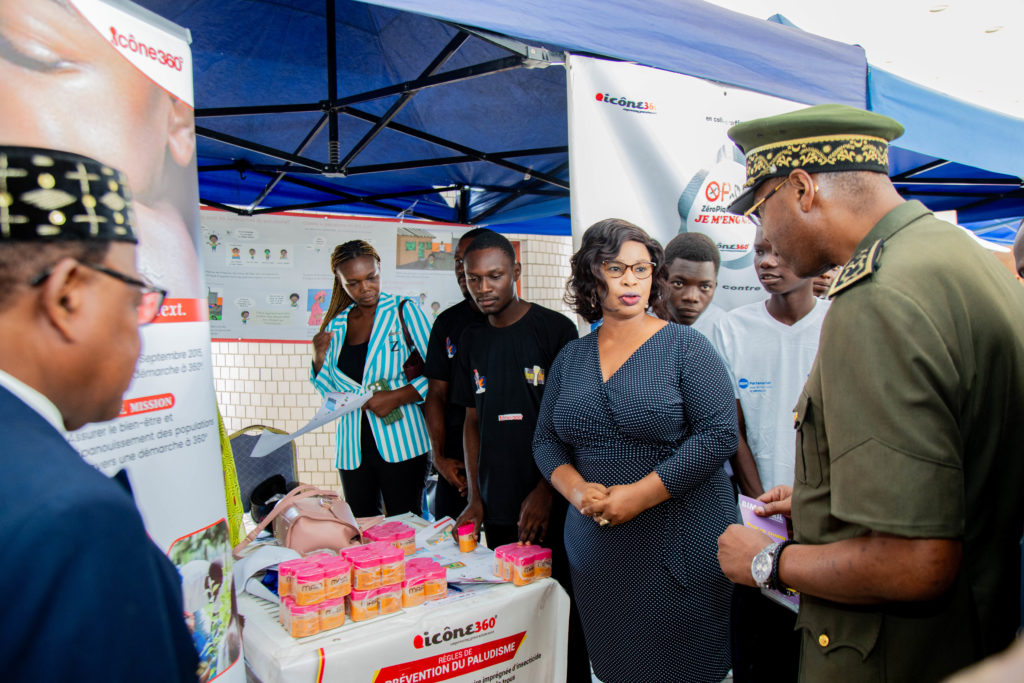
In line with this commitment, Icône 360° President Alavo Sessi Yvette represented CSOs on World Malaria Day in Benin with an information and mobilization stand, in her capacity as President of the National Coalition of Zero Malaria CSOs and Advisor to the Global Fund's CCM/INC. This positioning confirms the bridging role that these community leaders can play between local dynamics and national and international decision-making bodies.

In Togo, Dimension Humaine, led by Rachel Boyindjo, a member of C4SME (Civil Society for Malaria Elimination), benefits from two decades of experience in community sensitization, which she aims to leverage for advocacy focused on reducing access barriers for healthcare workers in the communities.
Malaria is a reality that ravages our communities and dramatically affects our daily lives. I urge national leaders to multiply efforts in mobilizing domestic resources for health, and especially for the fight against malaria. Rachel Boyindjo - Dimension Humaine
The Circle of Actions for the Development and Empowerment of Women and Children(CADEFE), chaired by ESSEH Afua Kafui, operates in the heart of the rural communities of the Plateaux region, where prevalence remains high, focusing on mass awareness and supporting women and young girls.
From Local Actions to Advocacy Ambitions
These organizations, each employing different approaches, share a common belief: malaria is a conquerable scourge, provided that action is taken close to the people, focusing on education, community mobilization, and dialogue with local authorities.
These experiences demonstrate how, starting from their local realities, these organizations can carry powerful advocacy messages to improve public health policies, influence local budget priorities, and deeply integrate prevention practices into community behavior.
Supporting and Amplifying the Voices of Change Makers
By recognizing the women leaders driving this fight, Voix EssentiELLES reaffirms its commitment: to acknowledge the strength of community organizations led by women and provide them with the tools to turn their actions into systemic change.
Through advocacy funding, capacity building, and creating spaces for influence, Voix EssentiELLES will support these organizations in amplifying their impact. Every trained community relay, every influenced local budget, and every myth debunked brings us closer to a common goal: a future where malaria is no longer an inevitable reality for women, girls, and the communities they serve.